
Bodies Fall Apart
Humans and the Things We Build, All Fall to Pieces

Ringo, my dog, has always been a lovely soul, a gentle mutt who is excited to be around people. At nearly 14 years old, his 30-pound body was giving out.
His health began to deteriorate. His eyes clouded over. Chronic stomach trouble revealed he had a large tumor. He lost weight but he was still upbeat and happy and, as far as we could tell, he was not in pain. Not yet.
Living bodies give out. There’s no way around that. Still, we try to stave this off as long as possible by taking care of ourselves. The benefits of eating well and exercising are understood, and yet, like millions of other Americans, I’ve avoided exercise for years. Actually, decades.
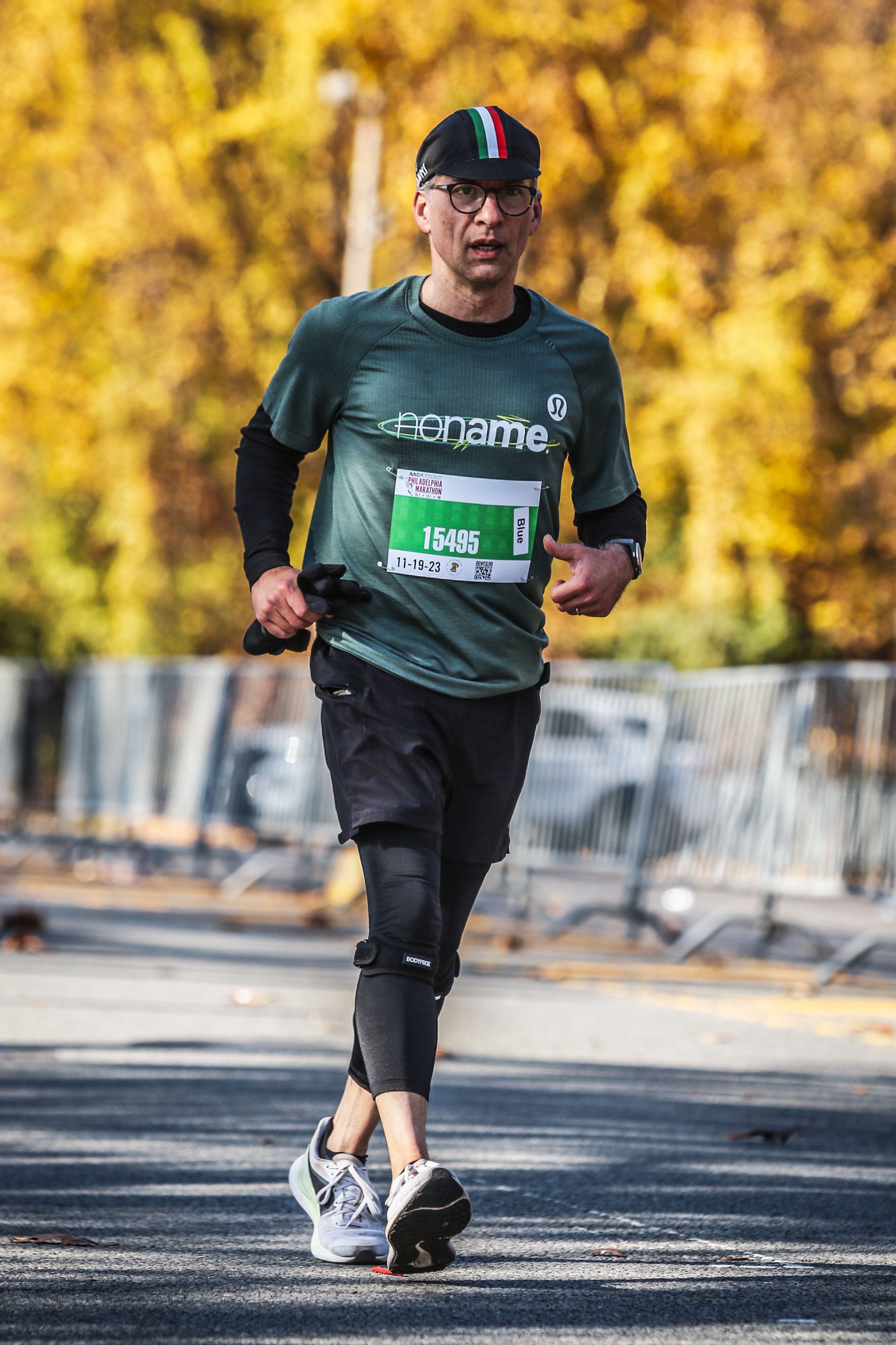
And yet, I ran the Philadelphia Marathon last November 19th. It was not only my first marathon, it was also my first race. I never seriously ran before July, but I got here because my body reminded me it’s going to stop working, maybe sooner than others’. The problem I face had been growing for many years, without me noticing.
In preschool, they tried to steer me right. Ambidextrous early on, I was pushed away from using those green-rubber-coated lefty scissors. My teachers actively stopped me from drawing and writing with my left hand. In my teens, with the self-righteousness of youth, I looked on this effort to break me of my cross-dominance as a forced conversion based on a millennia-old cultural bias toward right-handedness. Now, I’m inclined to view my earliest teachers more kindly. They probably understood that life would be tougher for lefties and discouraged me. Certainly, they couldn’t have known what was coming; I got lucky there.
I noticed a minuscule shaking in my left hand in my 20s. It was never much of a problem, not even when I was doing fine detail painting on 28mm-tall toy soldiers. I always loved modeling ships and planes, but especially soldiers; everything from 10-man squads of plastic Airfix WWII Imperial Japanese infantry to whole armies of lead, medieval Ottoman Janissaries numbering in the many hundreds of models, complete with cannons and wagon forts.
I eventually found other, similarly obsessed soldier enthusiasts and put my toy armies on the tabletop to face off against theirs using many-sided dice, tables and rulers to move units and resolve combats. I was very proud of my 14th Century Scots army; I was quite good at painting their eyes and banners, and even their homespun plaids, and I led them to victory many times against their tiny, lead foes. When I approached fifty, that changed. My eyes couldn’t see as sharply, and - frustratingly - my hands became less steady.
Tremors became worse in the cold, worse when I was lifting something heavy, and worse when I tried to exercise. And yet, there’s a tendency when you face incremental change to withhold acknowledgement of it. It’s hard to maintain that mindset when others see what you won’t recognize. A few years ago, a friend of mine and I stood in the cold, drinking tea. She remarked that I seemed to be shivering – but we both noticed it was only in my left hand, which held the tea.
The tremors later spread to the left leg, accompanied by a growing stiffness there. I assumed this was a side effect of medication, but when I went off the medication, I realized I might have a problem.
I went on a journey that you may recognize. Visits to doctors’ offices over a period of several months, followed by referrals to visit more doctors’ offices over many more months, revealed surprisingly little. Conflicting opinions were given, logged, noted, and puzzled over. The differing diagnoses began to feel like guesswork. It must be essential tremor, or dyskinesia as a residual effect of medication, because it was not Parkinson’s. That last was the only point of agreement between my physicians: not Parkinson’s.
Then, two years ago, my primary neurologist referred me to Dr. Stephen Frucht at NYU Langone. “Parkinson’s,” he said, definitively.
Bodies give out. At the end of their time, they fail. Even non-living bodies fall into entropy: metal fatigue and broken limbs, rust and cancer. Plants, animals, and humans and the things we build, all fall to pieces.
The marathon route in Philadelphia takes runners along the Delaware River, where I passed one of the largest things ever built: the Iowa-class battleship USS New Jersey. A real leviathan – nearly 900 feet long and displacing 60,000 tons, it was launched in 1942. It’s a museum ship now, though it’s officially part of the mothball fleet. If you’ve ever been past the Philadelphia Navy Yard, you may have seen this collection of more than 120 decommissioned vessels, held in storage.
As you drive over the Girard Point Bridge on Route 95, the fleet spreads out beneath you. It is an unearthly sight; row after row of destroyers, cruisers, frigates, support craft and even the aircraft carrier USS John F. Kennedy, the mothball fleet isn’t a ship graveyard, but at the same time, the ships in it aren’t alive. If needed, most of them could be recommissioned and brought back into service in as little as 20 days and up to four months, depending on their condition. Until then, they sit in limbo, moored together, missing the crews that would provide them with the souls that make them living bodies.
Eventually, all the ships in the mothball fleet will be scrapped. When their potential usefulness has passed, each vessel will be sold, towed to a breaker’s yard, and taken apart into digestible pieces. Much of their scrap will be melted down into fresh steel, to be reborn as something new: office buildings, automobiles, and homes.
While the idea of our bodies going through a similar journey back into the soil at the end of our lives doesn’t bother me, the idea of the things that we build that have had a job to do, and done it well, being discarded causes me unaccountable sadness. A derelict machine or an abandoned building breaks my heart. It’s as though their lives have ended, and the souls that once inhabited them have flown.
There is something terribly poignant in the empty space – the place where people were, but aren’t any more. The exhibit of victims’ shoes at the US Holocaust Museum is devastating, a visual poem that makes it possible to begin to understand loss on an unimaginable scale.
Near the beginning of William Wyler’s Academy-Award-winning film of GIs returning from WWII, “The Best Years of Our Lives”, the three protagonists fly over a graveyard of airplanes, clearly numbering in the thousands. At the end of the film, while one of them, played by Dana Andrews, walks through the same graveyard, passing row upon row of decaying aircraft, there’s no dialog. There doesn’t need to be; their mute presence, like rows of headstones, remind us of those who weren’t coming back.
Bodies, mechanical and organic, fall apart. As it turned out, in the case of my body, my doctor diagnosed benign tremulous Parkinson’s disease. “You got the least bad kind,” he said, and I joked at the time that it felt like I had won the $7 prize in a 500-million-dollar Powerball drawing. But that wasn’t the truth; there’s something comforting, and even a little euphoric, about getting a straight answer, even if the news isn’t good. An answer, however bad, gives you something to grab onto. It hangs a name on the unknown. It helps do away with fear.
I got…excited. The news never gave me reason to get angry, which I expected I might be. Instead, it prompted me to enumerate the silver linings I saw. At least I knew what the problem was. At least I didn’t have the form of Parkinson’s that assaulted my Grandmother’s nervous system and probably led to her death. At least I could take charge of a body I had, quite frankly, neglected.
Every second counts and I had wasted enough of them. I had no injuries, no major issues, all four limbs, a trunk and a head. My body was shaken, but it was not yet falling apart. “It’s time,” I thought, “to make use of it before I can’t.”
Though they’re inextricably linked, our bodies and selves are not the same. An athlete recognizes this. The realization that we essentially inhabit a miraculous, organic piece of machinery was one that moved me to act. I practiced Yoga. I began strength training to cope with the loss of muscle resulting from a torn bicep, which I think, ridiculously, happened while sitting at my desk, typing. Last summer, I started running for the first time. Even though I was always hungry and began eating more, I steadily lost about 20 pounds. On a Sunday last November, I ran a marathon.
While he was always hungry, Ringo lost weight, too. Much of what he ate fed his tumor. Early in December, he collapsed after his Saturday morning walk. I was just finishing a six-mile run in Brooklyn when my wife called to let me know.
After my wife administered a powerful painkiller to the dog, the family gathered around Ringo to make him more comfortable. We knew his body was going into a final failure and made arrangements to bring him to the emergency veterinarian practice on 24th Street to euthanize him, pending the doctor’s examination. She agreed there was nothing to be done except to end his pain.
We each said goodbye to him, comforted him and sat with him as he was put to sleep by the first injection. When he was unconscious, the final injection was administered. I felt his breathing stop and his body cease functioning.
I petted his head as I had done thousands of times before, noticing that the sight of my dog’s body didn’t fill me with sadness. It was simply there. The shell of his body remained, but he was gone.
It wasn’t until weeks later, as I thought back on that moment, that I remembered my father’s death a little more than two years earlier. I got a phone call from the memory care facility into which dad had just moved. That itself wasn’t surprising, but the timing of the call, almost exactly at 7 am, made me think perhaps it was THAT phone call. The voice on the other end of the line let me know John Francis Bianchi had died between 4 and 5:30 am.
By 10 am, I had driven to New Jersey and stood by dad’s bedside. He was gone.
His body, visibly diminished, was uninhabited. Being in the presence of his death didn’t make me cry; instead I simply sat with him, taking in the reality of that moment. I never would have thought to do this when my father was alive, but I reached up and touched his head. I ran my fingers through his hair. I thought, “this will be the last time I touch him.” But, he was already unreachable.
The morning after Ringo’s death, I left the house and went for our usual Sunday morning walk, for the first time without him. When I reached for my wallet to pay for coffee, I felt something in my pocket. I fished it out; confronted with the sight of his empty collar, I was overcome.
As Dana Andrews remarks in Wyler’s film: in the end, the junkman gets everything. Decay and death are constant companions, and rusted machinery, abandoned buildings and empty collars say more about loss than words can.
In the end, our bodies will fail. Our time will run out, and each life will leave an empty space. Now, every day, I think about how well I fill that space until I am no longer in it.
An absolutely beautiful essay, John. Just read it to Cat. Thank you for continuing to fill our space with the sounds, thoughts, and the wonderful physical presence you have whether playing an instrument, running a marathon, or just being.
wow. thanks for sharing! what a great piece of writing.